

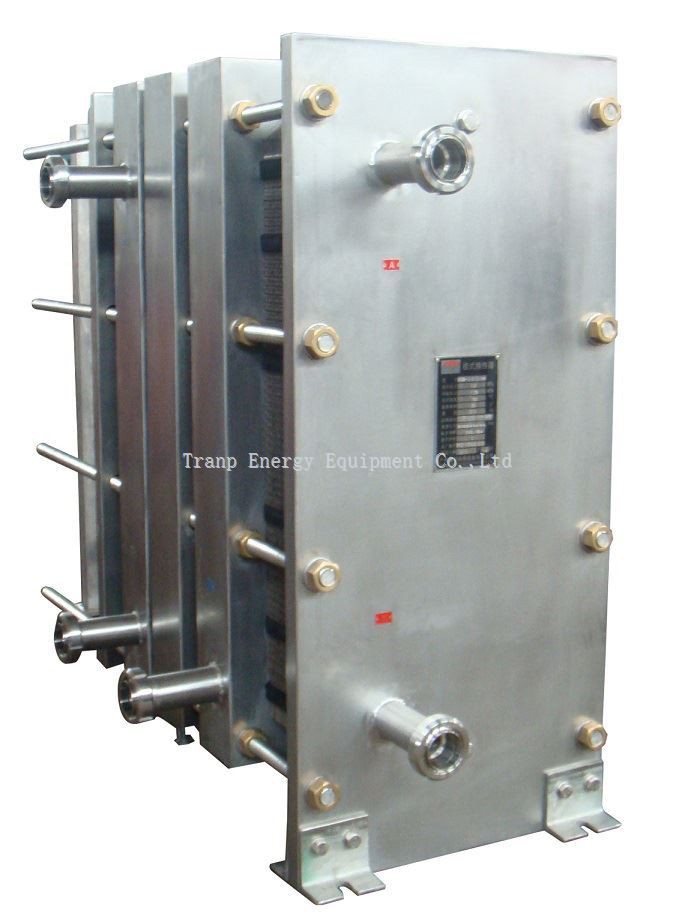
As the industry leader in this field, our products are being used in various countries and regions worldwide, we believe that our the heat exchange, fluid heat exchanger, Heat exchanger tube can help you to develop and maintain a competitive advantage. We adhere to the business model of independent production and fast delivery to reduce your procurement costs and save your procurement time. With good product quality and excellent customer satisfaction, to achieve vertical integration of diversified products.
Plate Frame Exchanger
Product Introduction
Plate and frame heat exchangers, a type of remouvable heat exchanger, are devices that offer high thermal performance, is a piece of equipment that ensures heat exchange between two fluids (liquid or air). Due to its design, it is particularly suitable for fluids containing particles. It is made of stainless steel and is widely used in industry.


This detachable plate heat exchanger allows the plates to be increased or decreased according to the need for heat transfer.
Material Design and Selections
For various applications and requirements, we provide many types of material.
Here is a simple common material sheet for reference.
Material Selection | ||
Plate Material | SUS304, SUS316L, SMO254, Ti, Ni, Hastelloy |  |
| Gasket Material | NBR, HNBR, EPDM,Viton/Flurorubber,Chloroprene, Silicone Rubber |  |
| Frame Material | Carbon Steel, Stainless Steel |  |
| *For specific requirements, please contact us for confirmation | ||
Corrugation type
type | code name |
V-type | R |
Horizontal straightness | P |
Spherical | Q |
slanted | X |
vertical | S |
Real Case Show in milk prodcution line
Heat exchanger is the core processing equipment in the milk production line. The purposes of heat treatment of milk are:
Sterilization to ensure safe consumption;
Raise the temperature of milk to a temperature that can be subsequently processed
In the milk production process, plate heat exchangers are used primarily for pasteurization. The process involves heating raw milk to specific temperatures before cooling it, to eliminate pathogens, such as bacteria, yeast, or mold, that may be present in the milk. By killing bacteria and other microorganisms, pasteurization helps to increase the shelf life of milk.
To achieve this, milk is pumped into one section of the plate heat exchanger and heated to a specific temperature using hot water or steam. The heated milk is then passed through the second section of the plate heat exchanger. Here, it comes in contact with cold water or chilled water, depending upon the milk's desired final temperature. The cold water helps to cool the milk quickly and efficiently, without compromising on quality.
Over the years, with the experience of solving practical production applications for customers, we have absorbed the essence of similar products at home and abroad to further improve the design and performance of our Hot Water Heat Exchanger. We adhere to the spirit of integrity and innovation, and consistently provide customers with high-quality and efficient services. 100% customer satisfaction is the ultimate goal of our company. Please do not hesitate to contact us!