

We are currently a professional Reactor Mixing Tank, wood stove water heat exchanger, intercooler heat exchanger manufacturer in China. The sense of quality and competition makes every employee understand that the success of the company lies not only in the quality of our products, but also in whether the customers are satisfied with the services we provide. High quality products must be supported by excellent services. Our company always takes 'creating perfect and practical good products for users' as the goal and takes integrity as our responsibility.
Product Description
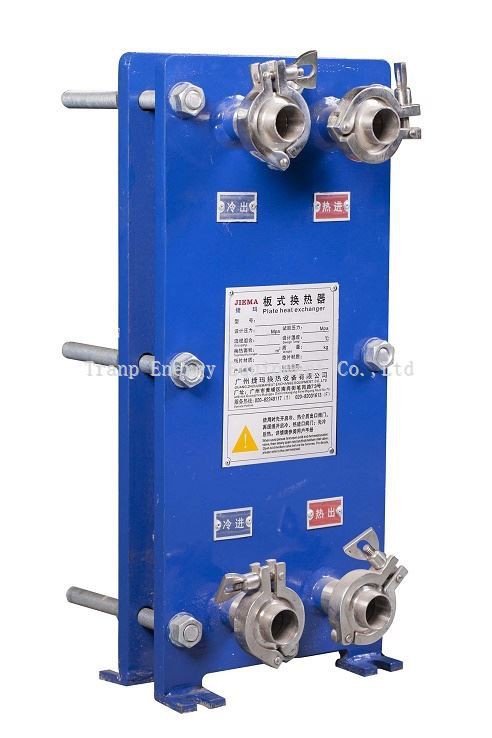
The plate heat exchanger is composed of stamped and formed concave and convex stainless steel plates. The concave and convex patterns between the two adjacent plates form a 180 degree relative combination, so the concave and convex ridges between the two plates of the plate heat exchanger form staggered contact points, and the contact points are combined by vacuum welding to form the high-pressure resistant staggered circulation structure of the plate heat exchanger, and these staggered circulation structures make the hot and cold fluids in the plate heat exchanger produce strong turbulent flow and achieve high heat transfer.
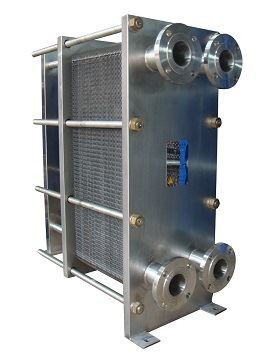
The plate heat exchanger is composed of a set of corrugated metal plates with four angular holes for the two fluids of heat transfer to pass through. The metal plates are mounted in a frame with fixed plates and movable compression plates on the side and clamped with clamping bolts. The plates are equipped with sealing gaskets that seal the fluid channels and guide the fluids alternately into their respective flow channels to form the heat exchange. The flow rate, physical properties, pressure drop and temperature difference of the fluid determine the number and size of the plates. The corrugated plates not only increase the turbulence level, but also form many support points, which are sufficient to withstand the pressure difference between the media. Metal plates and movable plates compression plates are suspended from the upper guide rod and positioned by the lower guide rod, while the rod ends are fixed to the support posts.
Conditions:
● Heat is always transferred from the hot medium to the cold medium.
● There must always be a temperature difference between the media.
● The heat loss from the heating medium is equal to the heat gained from the cold medium.


Material Design and Selections
For various applications and requirements, we provide many types of material.
Here is a simple common material sheet for reference.
Material Selection | ||
Plate Material | SUS304, SUS316L, SMO254, Ti, Ni, Hastelloy |  |
| Gasket Material | NBR, HNBR, EPDM,Viton/Flurorubber,Chloroprene, Silicone Rubber |  |
| Frame Material | Carbon Steel, Stainless Steel |  |
| *For specific requirements, please contact us for confirmation | ||
Applications
In HVAC systems, plate heat exchangers are used to maintain a comfortable temperature inside buildings. For example, in a typical air conditioning system, a plate heat exchanger is used to transfer heat between the chilled water and the air being circulated throughout the building. As warm air passes over the cold water, it is cooled and then returned to the building, while the water absorbs the heat and is then transported to the chiller for re-cooling. This cycle is repeated continually to maintain a consistent indoor temperature.
Q & A
Q: Are you trading company or manufacturer?
A: We are professional manufacturer specialized in heat exchanger and pressure vessel. And we have two mature factories in China.
Q: Can you do OEM and ODM?
A: Yes, OEM and ODM are both acceptable. The material, color and type are up to your choice.
Q: When can I get the price?
A: Usually we quote within 24 hours after we get your inquiry.
In order to continue to enhance our M10 Customized Gasket Plate Heat Exchanger for Water and Milk and provide more sophisticated features and performance, we actively introduce and learn from advanced technologies. Consistently serving customers is the only reason for our existence, and customer needs are the driving force behind our development. As a modern company, we need to not only establish a corporate philosophy of all things for customers, but also focus on the concept of mutual customer service within the company.