

The laws of thermodynamics are the collective name of the following four laws:
 | The zeroth law of thermodynamics: If two thermodynamic systems are in thermal equilibrium with the third thermodynamic system, then they must also be in thermal equilibrium. In other words, the heat balance is transferred. |
| The first law of thermodynamics is also the law of conservation of energy. Since Joule proved with incontrovertible and accurate experimental results that the transformation between mechanical energy, electrical energy, and internal energy satisfies the conservation relationship, people have believed that the law of conservation of energy is a universal basic law in nature. |
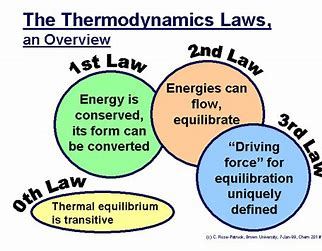
| There are several ways to express the second law of thermodynamics:Clausius stated: Heat can be transferred spontaneously from a high-temperature object to a colder object, but it cannot be spontaneously transferred from a low-temperature object to a high-temperature object;Kelvin-Planck stated: It is impossible to absorb heat from a single heat source and turn this heat into work without producing other effects.Entropy expression: As time goes on, the entropy in an isolated system will not decrease. |
According to the second law of thermodynamics, heat flows from a high temperature area to a low temperature area. This can be seen in our heat exchangers for HVAC applications.The HVAC system is responsible for reversing this natural flow, removing the hot air from the building in the hot summer, and placing it in the building in the cold winter.
| The third law of thermodynamics is usually expressed as absolute zero, the entropy of all perfect crystals of pure matter is zero. Or absolute zero (T=0K is -273.15℃) cannot be reached.R.H. Feller and E.A. Guggenheim also proposed another form of the third law of thermodynamics: No system can reduce its temperature to 0K through finite steps, which is called the 0K unreachable principle. |