The new cooling system consists of a liquid cooling device, a dry air liquid cooler, a preheating coil and a plate heat exchanger. After the cooling water is heated by the process heat treatment unit, it is cooled by a liquid cooling device or a water/ethylene glycol mixture through a plate heat exchanger. After the heat of the water/ethylene glycol mixture is transferred to the preheating coil of the air handling unit, the mixture is cooled and then further cooled by a dry air cooler installed on the roof. Since the cooling capacity is obtained from the outdoor air, the compressor does not operate.
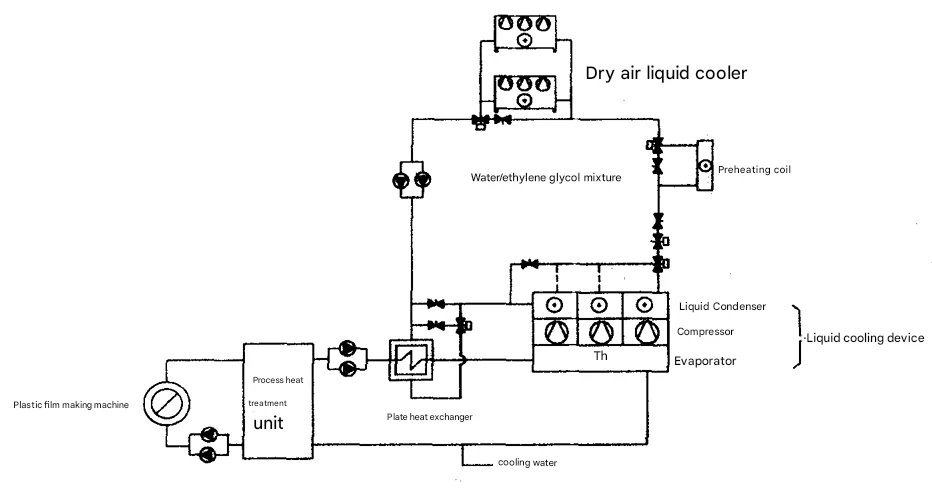
Operation mode
The cooling of the process can be completed by pre-cooling of the plate heat exchanger, or by a liquid cooling device using a compressor. Sometimes it can be completed by both. The operation mode is as follows:
(1) When the outdoor air temperature is greater than 19°C, only the compression refrigerator is used: the heat generated is discharged to the outside.
(2) When the outdoor air temperature is lower than 19°C but greater than 4°C, the compression refrigerator is used, and the recovered heat is used to preheat the air through the air handling unit.
(3) When the outdoor air temperature is lower than 4°C, the compression refrigerator is not used, and only the plate heat exchanger is used to cool the cooling water in the process, and the recovered heat is supplied to the air handling unit to preheat the air. The heat exchange area of the plate heat exchanger can be determined according to the flow rate, the physical properties of the liquid, the pressure drop and the temperature conditions.
Economic analysis
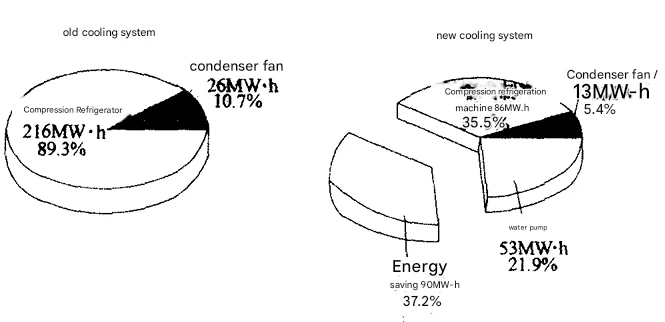
A large amount of electricity can be saved when the liquid cooling device is not used in winter. Power consumption of the new cooling system and the old cooling system.
When the power consumption of the circulating water/mixed liquid pump is taken into account, the new cooling system saves about 90MW·h/year. In addition, the liquid cooling unit has a shorter operating time throughout the year, which extends its life. Without the new cooling system, the maximum power load occurs in winter, but now the load is balanced in winter and summer.
The air handling unit can save about 110MWh of energy by preheating the air. Actual use shows that the system has a payback period of about 2.5 years.