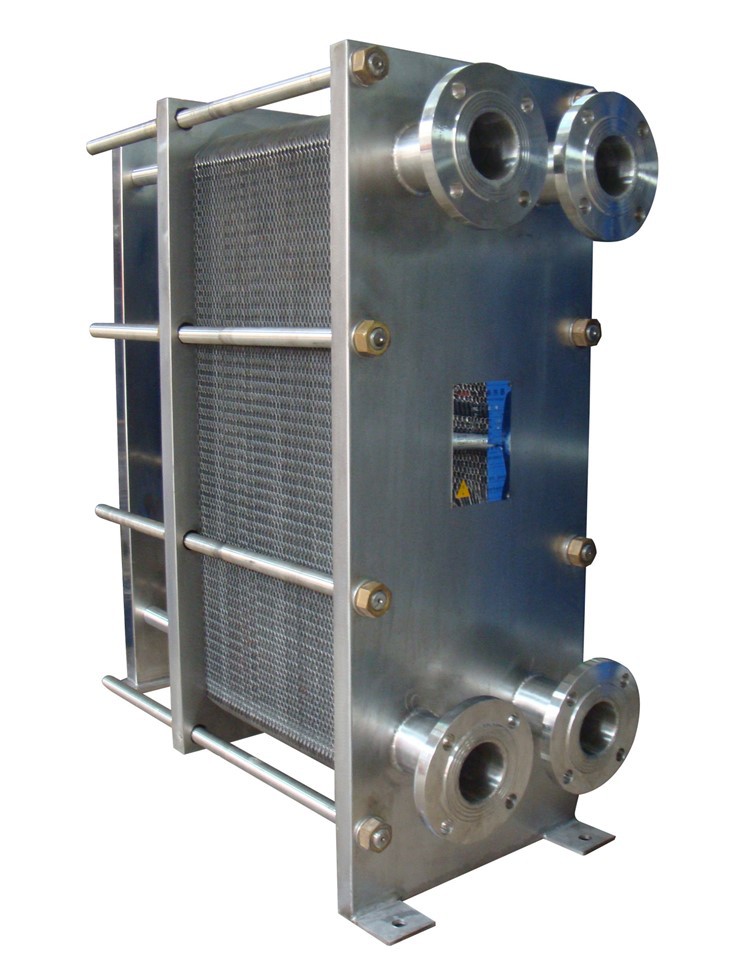
Causes of seal failure in plate heat exchangers
1. Time factor
For equipment that has been used or idle for several years, the aging of the sealing material itself may affect the reliability of the seal, so the new sealing gasket should be replaced in time during the overhaul.
2. Temperature factor
Rapid changes in temperature can also cause seal failure. When the temperature changes too quickly, the linear expansion coefficient of the rubber seal does not match the elastic deformation and the seal preload, causing the seal preload to decrease, resulting in the equipment's pressure bearing capacity being lower than the rated design pressure.
Preventive measures:
1) When operating the equipment, the pressure and temperature should be increased as smoothly as possible;
2) A preload spring can be added to the clamping stud to effectively compensate for the change in the seal preload and prevent leakage.
3. Pressure factor
When the detachable plate heat exchanger is used within the rated working pressure, it leaks. In addition to the quality factors of the equipment in manufacturing and assembly, it is mainly related to the abnormal impact load (water hammer, air hammer) in the system, which is not easy for general operators to observe. The instantaneous pressure peak caused by the impact is often 1 to 3 times higher than the normal working pressure, causing the rubber seal installed in the plate heat exchanger to shift and cause the seal to fail. Since the heat transfer components of this type of equipment are made of stainless steel thin plates (thickness 0.5 to 0.8 mm), the sealing rigidity is relatively poor and the sealing perimeter is very long, so the ability to withstand impact is much lower than other types of heat exchangers.
Preventive measures:
1) In view of the structural characteristics of the plate heat exchanger, the design pressure can be increased by 1.5 to 2 times when selecting the equipment according to the operating pressure;
2) Try to avoid impact in the system during use, such as adding anti-water hammer and air hammer devices in the pipeline and formulating strict operating procedures to prevent the operator from causing pipeline impact due to misoperation;
3) In applications where such accidents have occurred, measures to increase the thickness of the plate can also be taken according to the situation. The effect is obvious, but it will reduce the heat exchange efficiency.
plate heat exchanger