

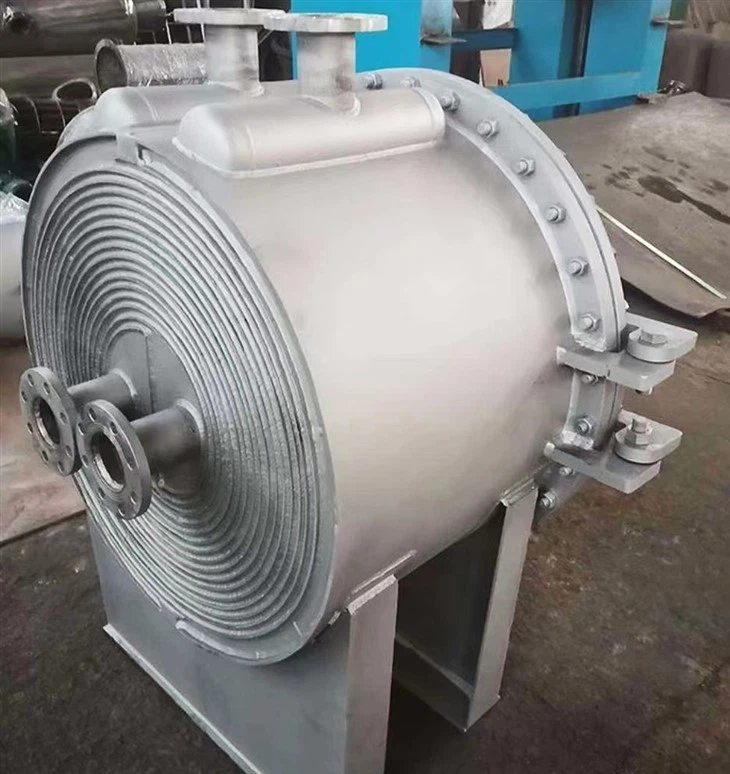
Heat transfer mechanism:
High turbulence: The spiral structure enhances fluid disturbance, and the heat transfer coefficient is 20~50% higher than that of shell and tube.
Self-cleaning: The single-channel design reduces dead zones and is suitable for impurity-containing media (such as clay suspension).
Heat recovery efficiency:
In the deodorization section, high-temperature oil exchanges heat with feed oil, and 60~70% of the heat can be recovered.
Here is the table of some typical working conditions, for reference only!
| Stage | Target Temperature | Pressure | Mediums characteristics | Material |
| Crude oil preheating | 60~85℃ | Low (0.3–0.5 MPa) | Contains phospholipids, FFAs | SS 304 |
| Bleaching heating | 90~110℃ | Low (0.2–0.4 MPa) | Contains clay particles | SS 304/316L |
| Deodorization preheating | 180~260℃ | Vacuum (<5 kPa) | High-temperature oil, anti-polymerization required | 316L/Special alloys |
| Deodorization cooling | 260℃ → 50℃ | Atmospheric | Rapid cooling required | SS 316L |
| Finished oil cooling | 50℃ → 25℃ | Atmospheric | May contain trace moisture | SS304 |
Functions of Spiral Plate Heat Exchanger
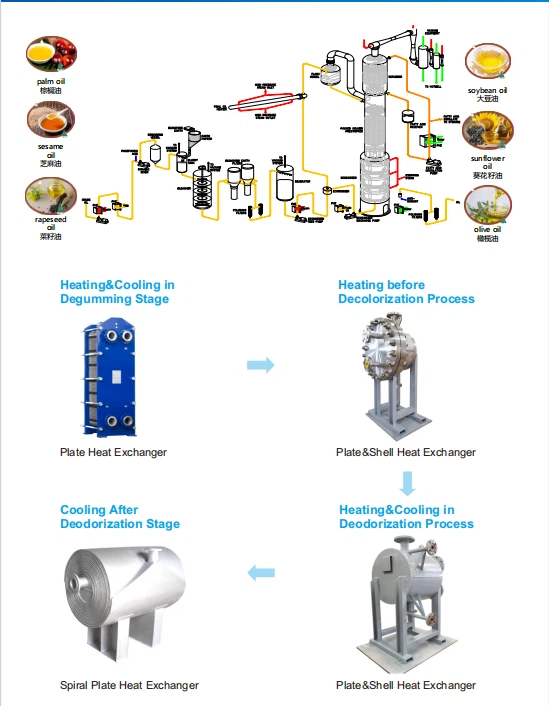
Crude oil preheating (before degumming/deacidification)
Decolorization section (white clay adsorption)
In the high temperature range (>100°C), attention should be paid to the heat sensitivity of grease (avoid local overheating).
It may contain trace amounts of clay particles and requires self-cleaning design.
Deodorization section (high temperature treatment)
Preheating: Heat the decolorized oil from 100°C to 180~260°C (before entering the deodorization tower).
Cooling: The high-temperature oil (~260°C) after deodorization is quickly cooled to below 50°C to prevent oxidation.
Heat recovery: Use the high-temperature oil after deodorization to preheat the feed oil, saving 30~50% energy.
High temperature (>200°C), low pressure (vacuum deodorization environment), the material needs to be resistant to high temperature (such as 316L stainless steel).
The cooling section needs to cool down quickly (to avoid acid return and color recovery).
Finished oil cooling (before packaging)
Cool the refined oil from 50~60°C to 25~30°C (packaging temperature).
Some processes use cold water or refrigerant (such as ethylene glycol) as the cooling medium. (Our water chiller can provide the chilled water)
In the low temperature range (<50°C), it is necessary to prevent the crystallization of oils and fats (for example, palm oil requires special temperature control).
different types of plate heat exchanger

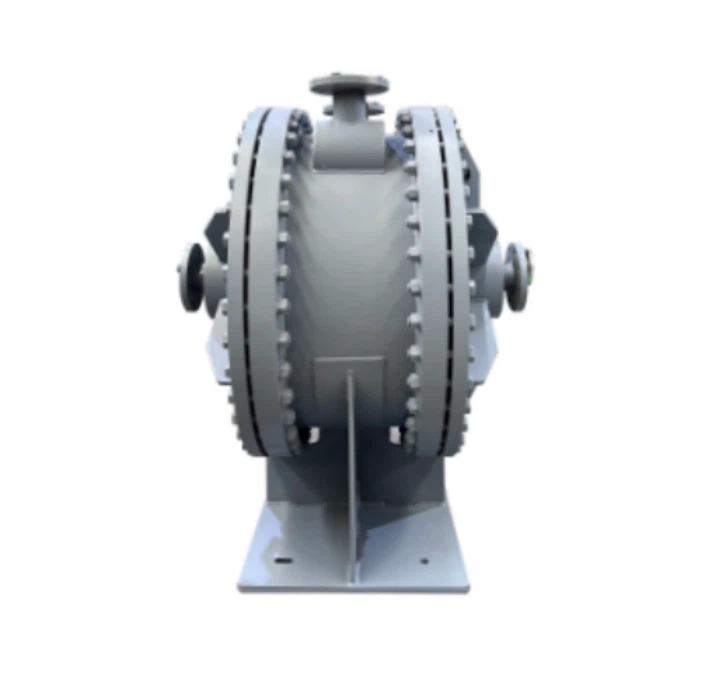

Hot Tags: spiral plate heat exchanger for edible oil refining, China spiral plate heat exchanger for edible oil refining manufacturers, suppliers, factory, evaporator heat exchanger