

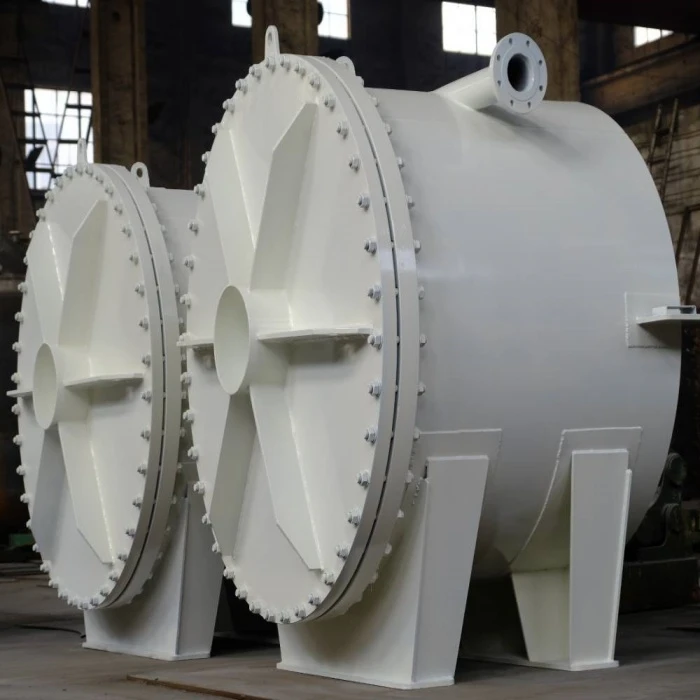
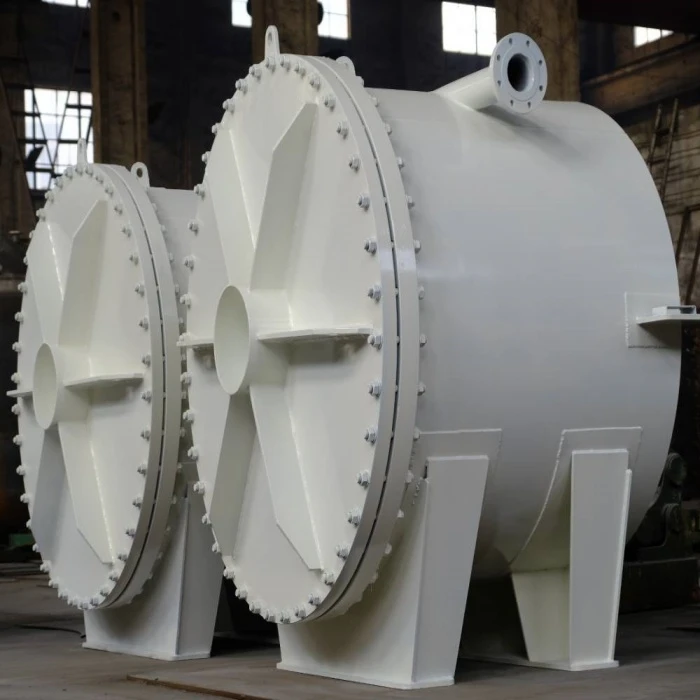
Why Choose Spiral Plate Heat Exchangers?
1. Strong Anti-Clogging Performance
- The spiral channel design (typical single-channel width ≥10mm) can handle sewage containing particles or sludge, resisting clogging. It is suitable for high-viscosity or fibrous media (e.g., sludge, industrial wastewater).
2. Self-Cleaning Capability
- High-speed rotational flow (typically 1-2 m/s) in the spiral channel generates centrifugal force, reducing fouling and maintenance frequency.
3. Compact and Efficient
- Heat transfer coefficient (K-value) can reach 2000-4000 W/(m²·K), 30%-50% higher than shell-and-tube exchangers, saving space.
4. Corrosion Resistance
- Materials like 316L stainless steel, titanium, or coated surfaces can withstand acidic/alkaline wastewater (e.g., pH 2-12).
5. High Temperature Difference Utilization
- Counterflow design enables efficient heat exchange even with small temperature differences (ΔT≥5°C), ideal for waste heat recovery (e.g., anaerobic digester heating).
Design and Selection Considerations
Channel Spacing
For solids content >3%, channel width ≥12mm; for fibrous impurities, ≥15mm.
Material Selection
General Wastewater: 316L stainless steel (resists Cl⁻ ≤200ppm).
High Cl⁻/H₂S Environments: Hastelloy C276 or titanium.
Strong Acids (pH<2): Graphite-lined or PTFE-coated.
Flow Velocity Control
Wastewater side: 1.0-1.5 m/s (low speed causes sedimentation; high speed increases wear).
Pressure Drop Limit
Typically ≤50 kPa to avoid excessive pump energy consumption.
Hot Tags: spiral plate heat exchangers in wastewater treatment, China spiral plate heat exchangers in wastewater treatment manufacturers, suppliers, factory, evaporator heat exchanger