

There are many types of motor loads, and the deviation may sometimes be large when applying the formula. Generally, larger motors have an ammeter to monitor and monitor the delay adjustment of the star-delta control startup. Generally, you can do this: press the start button to observe the current of the meter. At this time, the pointer of the watch may exceed the full scale value of the watch. With the increase of the motor speed, the current slowly decreases (the pointer gradually drops down). After the pointer reaches a certain position, it no longer drops down. When the triangle changes (that is, the time relay should be activated, it should be delayed for a maximum of 2 seconds for safety). This should be the most reasonable. Conversely, if the load is heavy, the force of the star-connected motor is only 1/3 of the triangle. The speed of the motor will not change after a certain degree of increase, but there is a certain distance from the rated speed. At this time, the current of the motor is often at the rated motor. 1.2 times more than that, it is not beneficial to switch in time under this condition, which is harmful and unhelpful (the thermal relay action that can be avoided may occur). Generally speaking, as long as it is a non-inertial device, the cage asynchronous motor below 75KW is not started with a star triangle. More than 5 seconds.
It depends on the load. If you ask more why and make it easier, many answers are there.
1. Why should the motor start with star-delta buck?
2. What is the role of the star in the process of starting the star triangle?
Answer 1. Star-delta starting is generally used for starting with larger power motors and heavier loads. The purpose is to reduce the large fluctuations in the grid voltage when the motor starts (the current of the full-voltage motor starting is about 4 to 7 times the rated value), which may affect the normal operation of other electrical equipment. For users with small transformer capacity and heavy load, if the star-delta buck is not used to start, the voltage fluctuation is particularly prominent.
Answer 2: When starting in star connection, each phase winding of the motor changes from 380V voltage added to 220V when full voltage is started. Under the same AC impedance, the starting current naturally drops greatly due to the significant decrease in voltage (starting current The maximum value is limited to about 2 times). In the short process after the star connection is energized, the motor completes the above four stages from standstill-rotation-acceleration-constant speed, and the current also continues to decline with these four processes. After reaching "constant speed, the current no longer drops. Stop a certain value. At this point, the star-started "historical task has been completed. Here we must highlight: "If the star start task has been completed, if you wait for 5 seconds, 10 seconds, and 15 seconds, it will not affect the speed of the motor. What will change, this waiting is futile (heavier load may also cause the thermal relay to operate). Therefore, after the star start is completed (at "constant speed"), the time relay should be activated (transition) because the motor is running with load In the end it was carried out in a triangular state.
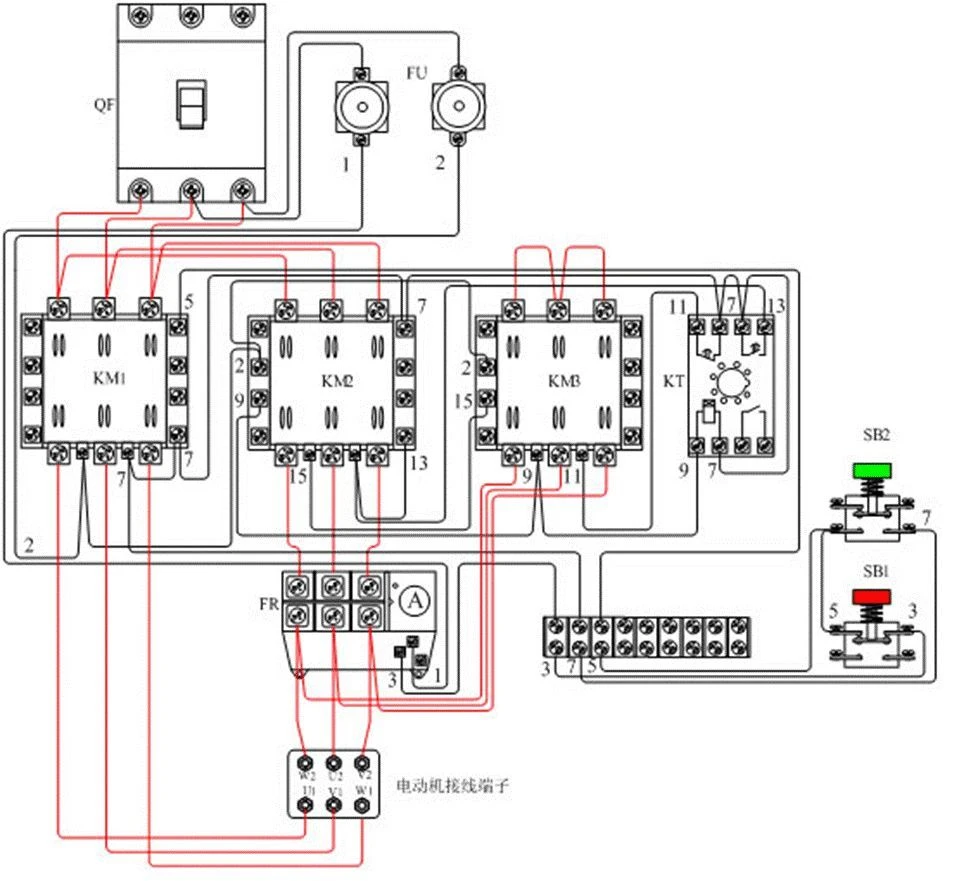
General speaking:
A. Star start is to convert 380V voltage to 220V voltage and start on the winding, thus limiting the starting current.
B. Accelerate the motor from a static state to a certain speed and maintain it at this speed (the speed may be close to the rated value of the motor or it may have a certain gap with the rated speed, which is determined by different loads. This state is achieved because of this The motor has exhausted its maximum capacity (only 1/3 of the torque).
It is then transferred to the triangle. In other words, the triangle is "relaying", and the motor with a relatively high speed is connected to the rated speed through the full voltage (380V). (The instantaneous current of the conversion will jump. But there is no much impact), driving the load to run normally.