

The frequency converters are used in much the same way. Several common methods for controlling frequency converters are introduced.
1. Wiring method of inverter main circuit:
The three terminals of R S T are the input end of the power supply of the inverter, and the three live wires are connected. U V W is the motor that needs to be controlled by the outlet termination.
First of all, the inverter has several power supply specifications such as single-phase 220V, three-phase 220V, three-phase 380/480V, three-phase 690V, etc. We need to select the appropriate power supply and circuit breaker according to the inverter specifications. Connect the input power to the L1, L2 (single-phase 220V) or R, S, T terminals of the inverter. No contactor is generally added between the circuit breaker and the inverter. If the contactor must be added, it should be noted that the contactor cannot be operated or frequent. In addition, in order to improve the power factor and eliminate the interference, AC input reactor and noise filter can be added on the input side, which can be added or not according to needs and use occasions. Connect the input side, connect the three-phase motor to the output terminals U, V and w of the inverter. It should be noted that capacitors or surge suppressors cannot be added on the output side of the inverter, otherwise the inverter will be damaged. Finally, ensure that the ground terminal is reliably grounded to ensure the safety of equipment and personnel.
2. Types of control methods:
1. Panel control mode. This control method is to start and stop the inverter to modify the frequency through the inverter panel.
2. Via external controller or instrument control mode. This control method is mainly through the controller such as start and stop signal and frequency signal to the inverter. This control method can be divided into two types according to the different signal types. One type is a switching signal and an analog signal, and the other is a communication digital signal.
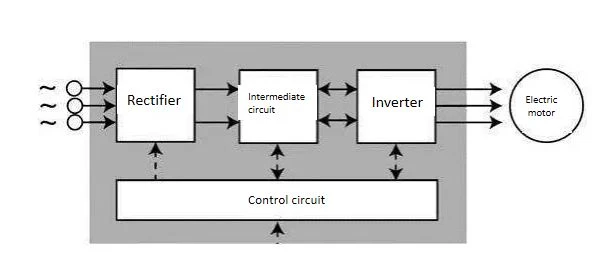
The terminal numbers and functions of different brands of inverters in the control circuit part will be different, we can judge according to the inverter manual.
First of all, we have to choose the control mode and find the corresponding parameters in the parameter settings for setting. The control modes are divided into operation panel command channel, terminal command channel and communication command channel.
When the command channel of the operation panel is selected, the RUN and STOP keys on the panel can realize the operation and stop of the inverter, and the motor speed can be adjusted by the increment and decrement keys. Here to talk about, some inverters are equipped with a potentiometer on the operation panel. In the settings, select the analog input as the on-board potentiometer, and adjust the potentiometer to achieve motor speed regulation. In addition, the panel of the inverter can be removed, and the panel can be installed on the panel of the operation cabinet for operation through an extension cable.
Using the terminal command channel, two-wire or three-wire control can be selected by setting parameters. For two-wire control, we only need to close the forward and reverse terminals and the common terminal of the power supply to realize the forward and reverse rotation of the motor. In three-wire control, it is necessary to close the positive terminal and the common terminal before the positive and negative terminals and the common terminal are closed to work. In terms of analog input, the inverter provides +10V power. We can use external potentiometers, various sensors, etc. as needed to achieve motor speed regulation. The inverter can choose whether the analog signal is voltage signal or current signal through parameter setting or jumper switch, and the communication command channel controls the inverter through host computer communication.
In order to make the motor run better, we also need to set the motor parameters, acceleration and deceleration time, operating frequency, etc. Finished by HVAC South. Basically, these simple settings can realize the inverter to control the operation of the motor.
In use, according to the actual situation, it may be necessary to add a braking resistor or braking unit, etc., to set the inverter parameters in more detail. My understanding of the inverter is also limited to simple use, and the complicated settings are not very well understood. I hope you can provide valuable comments. Finally, remind everyone that you must be reliably grounded! ! !
3. Control circuit wiring.
Wiring for panel control: The simplest panel control is the one with the least wiring. The enable terminal of the inverter must be wired, and the inverter must be enabled first regardless of the control method! Potentiometer wiring, if you think the buttons on the panel are not convenient, you can use the potentiometer to adjust the frequency. Some inverters have installed potentiometers on the panel, some are not installed, but there are reserved potentiometer terminals!
Wiring through external controller or instrument control mode: This mode has different wiring modes according to different signal types.
1. The wiring method that depends on the switch and analog control needs to be connected to the enable terminal, the start terminal, and the frequency given terminal is generally a current or voltage signal. If it is a closed-loop control regulated by pld, the external sensor signal needs to be connected to the inverter. Signal acquisition terminal.
2. Relying on the communication method to control the inverter wiring method requires connecting the enabling terminal, and the communication cable can be connected to the communication port of the inverter and the communication partner.
4. Inverter parameter setting
1. Panel control parameters: motor power; control mode: panel; frequency given mode: panel/potentiometer; frequency upper and lower limits; different inverter parameters have subtle differences!
2. Switching quantity and analog quantity control mode parameters: motor power; control mode: remote; frequency setting: external analog quantity; external analog quantity channel: according to the wiring, whichever one is connected, choose which one; external analog quantity Channel signal type: According to the type of analog signal output by plc, there are generally current and voltage signals. The signal range is determined according to the actual plc analog output channel. Commonly used 4 to 20ma, 0 to 10v; plc side needs to write a control program.
3. Digital communication signal parameters: motor power; control mode: communication; communication address: can also be said to be the station number; communication protocol: use the communication protocol supported by both the inverter and the PLC; the PLC side needs to write a communication program!
发送反馈
历史记录